

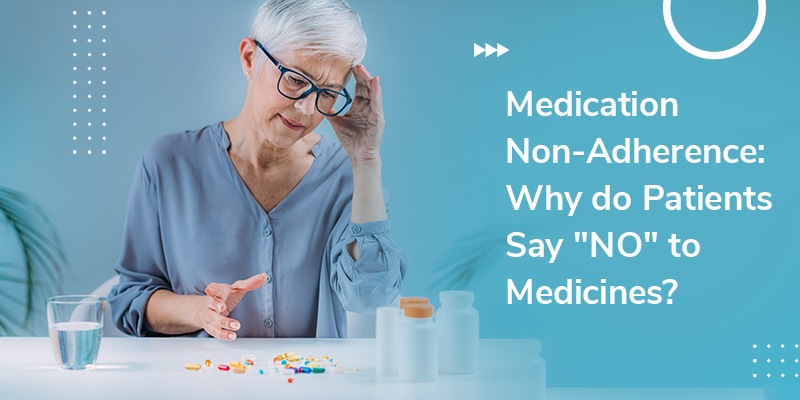
Medication Non-Adherence: Why do Patients Say "NO" to Medicines?

Medication non-adherence: What is it and Why Should We be Worried?
The fancy term that translates to patients saying "NO" to their prescribed medication is fast becoming a common problem.
Let's face the truth. No one likes taking medication unless it gives you immediate relief from pain or a threatening medical condition. However, medication non-adherence is becoming extremely common among patients with chronic medical conditions.
Statistics say that medication non-adherence affects nearly 40%-50% of the patients in the US who need to manage conditions like hypertension and diabetes. Moreover, non-adherence to prescribed treatment causes at least 100,000 preventable deaths every year.
In this scenario, partial non-adherence is becoming more habitual than complete discontinuity. Although some patients rationalise their medication course without harm, partial non-adherence can also have detrimental effects.
Let's face the elephant in the room: Why are patients refusing to take their medications? Our compilation of reasons will certainly be an eye-opener on this topic.
Top 8 Reasons for Medication Non-Adherence
Out of a billion medical prescriptions written yearly, more than half are not followed. Why is medication adherence a big challenge? Experts point to several barriers contributing to the alarming statistics and health outcomes.
They are:
1. Fear
There's no doubt that all patients want a cure for their ailment but fear the medicines that may give them exactly what they want. There is a general apprehension about taking medication for long-term illnesses. People often fear the adeverse effects of medications or have had unfortunate experiences with them in the past. This fear is heightened by gossip, rumours, and versions from family and friends. Patients may also stop following medications for fear of relying on them for the rest of their lives.
2. Lack of trust
A small rumour or controversy can spark mistrust amongst patients, making them question the doctor's motive in prescribing medications for chronic illnesses. Today, patients are easily influenced by social media feeds and sensationally-titled videos that harp about pharma companies manipulating physicians' prescription intentions and patterns. A small seed of mistrust is enough to make patients wary about life-saving medicines.
3. Lack of proper understanding
Unfortunately, patients sometimes tend to misunderstand the very purpose of the prescription. This misunderstanding is common for mental health medications, which do not attribute to any physical changes. In these scenarios, many patients tend to discontinue when:
- The condition is temporarily controlled.
- There are no remarkable "physical changes."
They do not understand the need to take medication for a long duration to experience sustainable results.
4. Burden of cost
Medication is not cheap. This is an undeniable fact. Cost plays a significant role in medication adherence, and millions of patients defer purchasing life-saving drugs due to the pricing. Regrettably, patients often do not fill their medication owing to their lack of affordability.
5. Excessive number of medications
Patients with multiple chronic conditions like diabetes, hypertension, and heart diseases end up with a long prescription of drugs for each ailment. Known as Polypharmacy, this can lead to several challenges like:
- Confusion with the prescription instructions
- Choosing to take only "important" drugs
- Partial or complete non-adherence to the prescription
These challenges can be extremely detrimental to the patient's health and exacerbate chronic conditions.
6. Lack of Symptoms
Patients on long-term medication often see no reason to continue with it once they stop experiencing symptoms like pain, discomfort, etc. Moreover, they tend to believe that the medication has lost its effectiveness when they do not experience any visible changes.
7. Forgetfulness Due to Lack of Schedule
Let's take, for instance, patients who need to take more than half a dozen medicines at various times of the day. The medication may sometimes bear specific instructions like after-meal or before-meal dosages. Unless scheduled, all this information can be overwhelming for patients, especially the elderly or those who have a very busy schedule. Most often, they may forget to take the prescribed medicine.
8. Depression and reluctance
Depending on their diagnosis, patients may experience depression in association with taking medication. When depressed, patients may not take their prescribed medications. Additionally, shame or embarrassment can dissuade some patients from taking medication.
The act of swallowing a pill appears simple enough. However, it can be an arduous task for patients whose lives depend on long-term medication. Non-adherence is detrimental to the patient's health and a huge waste of money and effort. Fortunately, doctors and caregivers can implement some simple steps to encourage medication adherence amongst their patients.
Also Read: Supporting Young Minds to Thrive
Guidelines to Encourage Medication Adherence & Patient Compliance
Guidelines for doctors:
- Use easy-to-understand terms instead of complex medical jargon when explaining the prescription and its importance.
- Encourage the patient to repeat the instructions to make sure the patient knows what to do.
- Take the time to build a good rapport and foster an ideal relationship with the patient. The more confidence they have in your abilities, the better they will follow your orders.
- Simplify the dosage by adjusting the schedule so that all the medication can be consumed at one particular time of the day.
- Share reviews about the medication and its positive effects to instil confidence in the patient's mind.
- Explore and recommend tools and technology to assist patients in maintaining adherence.
- Educate patients on the importance of following medication regimens and the risks of non-adherence.
- Help overcome the burden of cost by checking on the patient's budget, income, and financial ability.
Guidelines for caretakers
Caretakers play an equally significant role in helping maintain medication adherence for friends or family members. Caregiving is a tough job, and it can easily lead to frustrations when the person refuses to cooperate with medication adherence. To make things easy for the patients, caretakers can follow a better approach by:
- Organising and scheduling the medication.
- Asking doctors for timely advice and evaluation of the prescription.
- Centralising pharmacy details to ensure reliable pharmacists are on call at any time.
- Reviewing and updating prescriptions after a consultation, hospitalisation, or an emergency.
- Seeking professional consultation, if necessary, and encouraging the patient to talk openly about their mental barriers.
One may need to go the extra mile to improve medication adherence by relying on education, support systems, motivational techniques, and technology. A digital companion like REAN HealthGuru can make a huge difference and simplify the task for the patient, caretaker, and doctors involved.
How REAN HealthGuru Helps With Medication Adherence
REAN HealthGuru is a wholesome tech solution that helps patients have full control over their medication by:
- Connecting with the patients and learning more about their medication and dosages.
- Engaging and implementing multiple resources to support their ongoing treatment.
- Setting timely reminders for better medication adherence.
- Connecting with patients with similar prescriptions to learn the benefits and positive outcomes of the medication regimen.
The Final Thoughts
Doctors can prescribe the best therapies and the costliest medicines. Friends and family can provide support and motivation. However, at the end of the day, nothing will work unless the patient takes the medication. Medication adherence is a big challenge, but one that can definitely be overcome with moral support and technical help from REAN HealthGuru. Click here to know how our app can help you.
Medication non-adherence: What is it and Why Should We be Worried?
The fancy term that translates to patients saying "NO" to their prescribed medication is fast becoming a common problem.
Let's face the truth. No one likes taking medication unless it gives you immediate relief from pain or a threatening medical condition. However, medication non-adherence is becoming extremely common among patients with chronic medical conditions.
Statistics say that medication non-adherence affects nearly 40%-50% of the patients in the US who need to manage conditions like hypertension and diabetes. Moreover, non-adherence to prescribed treatment causes at least 100,000 preventable deaths every year.
In this scenario, partial non-adherence is becoming more habitual than complete discontinuity. Although some patients rationalise their medication course without harm, partial non-adherence can also have detrimental effects.
Let's face the elephant in the room: Why are patients refusing to take their medications? Our compilation of reasons will certainly be an eye-opener on this topic.
Top 8 Reasons for Medication Non-Adherence
Out of a billion medical prescriptions written yearly, more than half are not followed. Why is medication adherence a big challenge? Experts point to several barriers contributing to the alarming statistics and health outcomes.
They are:
1. Fear
There's no doubt that all patients want a cure for their ailment but fear the medicines that may give them exactly what they want. There is a general apprehension about taking medication for long-term illnesses. People often fear the adeverse effects of medications or have had unfortunate experiences with them in the past. This fear is heightened by gossip, rumours, and versions from family and friends. Patients may also stop following medications for fear of relying on them for the rest of their lives.
2. Lack of trust
A small rumour or controversy can spark mistrust amongst patients, making them question the doctor's motive in prescribing medications for chronic illnesses. Today, patients are easily influenced by social media feeds and sensationally-titled videos that harp about pharma companies manipulating physicians' prescription intentions and patterns. A small seed of mistrust is enough to make patients wary about life-saving medicines.
3. Lack of proper understanding
Unfortunately, patients sometimes tend to misunderstand the very purpose of the prescription. This misunderstanding is common for mental health medications, which do not attribute to any physical changes. In these scenarios, many patients tend to discontinue when:
- The condition is temporarily controlled.
- There are no remarkable "physical changes."
They do not understand the need to take medication for a long duration to experience sustainable results.
4. Burden of cost
Medication is not cheap. This is an undeniable fact. Cost plays a significant role in medication adherence, and millions of patients defer purchasing life-saving drugs due to the pricing. Regrettably, patients often do not fill their medication owing to their lack of affordability.
5. Excessive number of medications
Patients with multiple chronic conditions like diabetes, hypertension, and heart diseases end up with a long prescription of drugs for each ailment. Known as Polypharmacy, this can lead to several challenges like:
- Confusion with the prescription instructions
- Choosing to take only "important" drugs
- Partial or complete non-adherence to the prescription
These challenges can be extremely detrimental to the patient's health and exacerbate chronic conditions.
6. Lack of Symptoms
Patients on long-term medication often see no reason to continue with it once they stop experiencing symptoms like pain, discomfort, etc. Moreover, they tend to believe that the medication has lost its effectiveness when they do not experience any visible changes.
7. Forgetfulness Due to Lack of Schedule
Let's take, for instance, patients who need to take more than half a dozen medicines at various times of the day. The medication may sometimes bear specific instructions like after-meal or before-meal dosages. Unless scheduled, all this information can be overwhelming for patients, especially the elderly or those who have a very busy schedule. Most often, they may forget to take the prescribed medicine.
8. Depression and reluctance
Depending on their diagnosis, patients may experience depression in association with taking medication. When depressed, patients may not take their prescribed medications. Additionally, shame or embarrassment can dissuade some patients from taking medication.
The act of swallowing a pill appears simple enough. However, it can be an arduous task for patients whose lives depend on long-term medication. Non-adherence is detrimental to the patient's health and a huge waste of money and effort. Fortunately, doctors and caregivers can implement some simple steps to encourage medication adherence amongst their patients.
Also Read: Supporting Young Minds to Thrive
Guidelines to Encourage Medication Adherence & Patient Compliance
Guidelines for doctors:
- Use easy-to-understand terms instead of complex medical jargon when explaining the prescription and its importance.
- Encourage the patient to repeat the instructions to make sure the patient knows what to do.
- Take the time to build a good rapport and foster an ideal relationship with the patient. The more confidence they have in your abilities, the better they will follow your orders.
- Simplify the dosage by adjusting the schedule so that all the medication can be consumed at one particular time of the day.
- Share reviews about the medication and its positive effects to instil confidence in the patient's mind.
- Explore and recommend tools and technology to assist patients in maintaining adherence.
- Educate patients on the importance of following medication regimens and the risks of non-adherence.
- Help overcome the burden of cost by checking on the patient's budget, income, and financial ability.
Guidelines for caretakers
Caretakers play an equally significant role in helping maintain medication adherence for friends or family members. Caregiving is a tough job, and it can easily lead to frustrations when the person refuses to cooperate with medication adherence. To make things easy for the patients, caretakers can follow a better approach by:
- Organising and scheduling the medication.
- Asking doctors for timely advice and evaluation of the prescription.
- Centralising pharmacy details to ensure reliable pharmacists are on call at any time.
- Reviewing and updating prescriptions after a consultation, hospitalisation, or an emergency.
- Seeking professional consultation, if necessary, and encouraging the patient to talk openly about their mental barriers.
One may need to go the extra mile to improve medication adherence by relying on education, support systems, motivational techniques, and technology. A digital companion like REAN HealthGuru can make a huge difference and simplify the task for the patient, caretaker, and doctors involved.
How REAN HealthGuru Helps With Medication Adherence
REAN HealthGuru is a wholesome tech solution that helps patients have full control over their medication by:
- Connecting with the patients and learning more about their medication and dosages.
- Engaging and implementing multiple resources to support their ongoing treatment.
- Setting timely reminders for better medication adherence.
- Connecting with patients with similar prescriptions to learn the benefits and positive outcomes of the medication regimen.
The Final Thoughts
Doctors can prescribe the best therapies and the costliest medicines. Friends and family can provide support and motivation. However, at the end of the day, nothing will work unless the patient takes the medication. Medication adherence is a big challenge, but one that can definitely be overcome with moral support and technical help from REAN HealthGuru. Click here to know how our app can help you.
About The Author